
What Hand Beats What Hand in Poker: A Friendly Guide
If you’ve ever been in a heated poker game, you know the thrill (and occasional confusion) of comparing your cards to an opponent’s. Which hand takes the win? And how do you figure it out quickly so you don’t make a costly mistake? Let’s walk through the standard poker hand rankings—what beats what—and why it matters for your strategy.
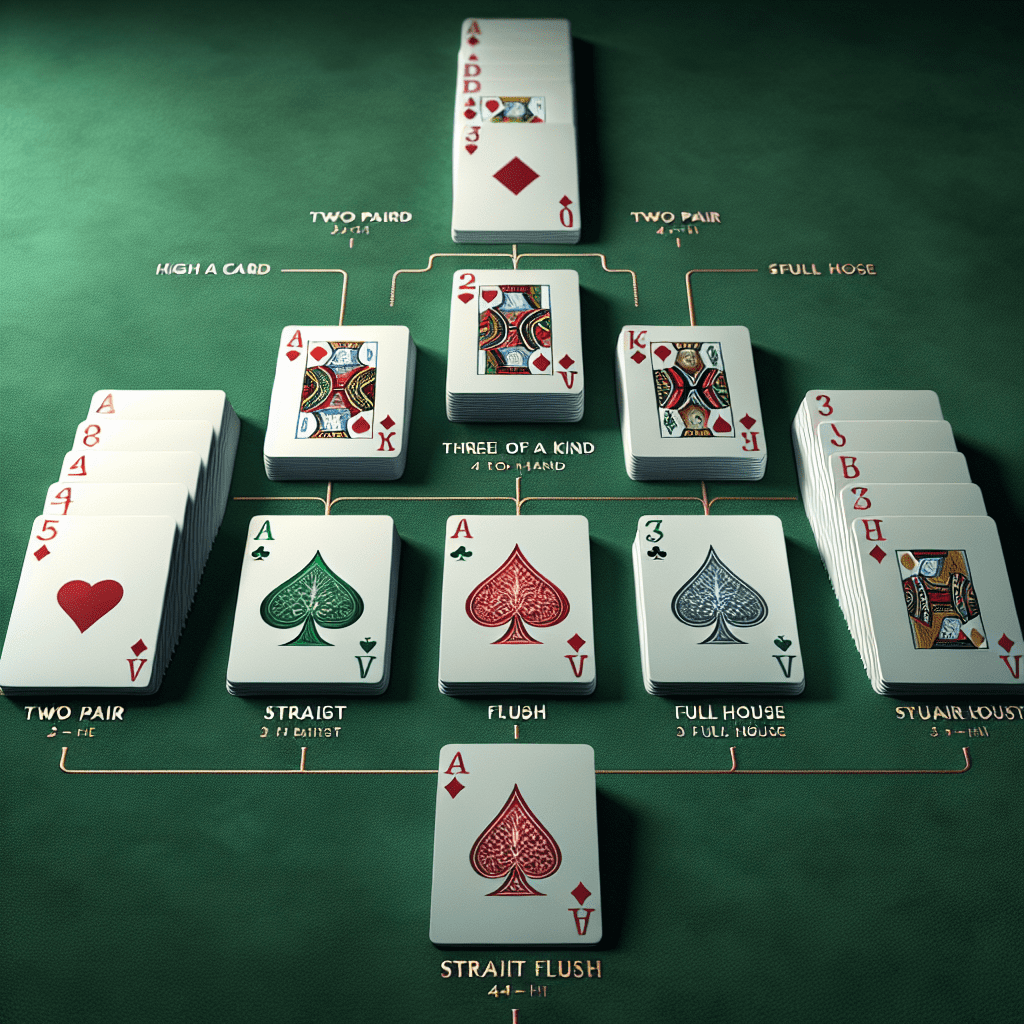
The Ten Basic Poker Hands, Ranked Highest to Lowest
- Royal Flush
What It Is: A, K, Q, J, 10, all in the same suit (like hearts).
Why It’s Awesome: It’s the rarest, most unbeatable hand. If you get this, savor the moment—you might not see it again for a long time. - Straight Flush
What It Is: Five consecutive cards, all the same suit (e.g., 5♥ 6♥ 7♥ 8♥ 9♥).
Just Below Royal: A Royal Flush is technically the best possible straight flush (A-K-Q-J-10). - Four of a Kind
What It Is: Four cards of the same rank (like A♠ A♥ A♦ A♣ plus any fifth card).
Power Factor: Extremely strong—very few hands can beat it. - Full House
What It Is: Three of a kind plus a pair (e.g., 7♣ 7♠ 7♥ and 4♦ 4♣).
Why It’s Tricky: It often looks unstoppable, but can fall short to quads or any straight flush. - Flush
What It Is: Five cards all in the same suit, not in a sequence (like A♣ 9♣ 6♣ 3♣ 2♣).
Tie-Breaker: The flush with the highest card wins (Ace-high flush beats King-high flush). - Straight
What It Is: Five consecutive cards, suits can vary (e.g., 8♠ 7♦ 6♣ 5♥ 4♦).
Ace Can Go High or Low: A-2-3-4-5 (Ace counts as 1) or 10-J-Q-K-A (Ace is high). - Three of a Kind
What It Is: Three cards of the same rank (like 5♣ 5♦ 5♠).
Strong Enough: It often outdoes pairs, but still folds to straights, flushes, and above. - Two Pair
What It Is: Two different pairs (e.g., 9♠ 9♥ and 4♦ 4♣).
Tie-Breaker: The higher of the two pairs matters first, then the kicker if needed. - One Pair
What It Is: Two cards of the same rank (like Q♣ Q♦).
Common Hand: You’ll see this a lot, but it’s often overshadowed by stronger combos. - High Card
What It Is: If none of the above hands apply, your best card is your “high card.”
Least Powerful: That means if someone has a pair, flush, etc., you lose unless they also have no combinations and your card outranks theirs.
Hand-to-Hand Showdowns: Some Examples
Full House vs. Flush
Full House: K-K-K-2-2 vs. Flush: A-9-7-3-2 of hearts.
Winner: Full House. Even though a Flush looks fancy, the Full House outranks it.
Straight vs. Three of a Kind
Straight: 5-6-7-8-9 vs. Three of a Kind: Three 10s.
Winner: Straight. A Straight beats Three of a Kind in standard poker rankings.
Royal Flush vs. Straight Flush
If one player has a Royal Flush (A-K-Q-J-10 of spades) and another has a Straight Flush (9-8-7-6-5 of clubs), the Royal Flush automatically wins.
Probability: Rare Hands Mean Strong Hands
Why do some hands outrank others? Because they’re harder to get. For instance:
- Odds of Royal Flush: ~1 in 649,740
- Odds of Straight Flush: ~1 in 72,193
- Odds of Four of a Kind: ~1 in 4,165
The rarer the hand, the higher it climbs in the hierarchy. That’s why a Flush beats a Straight, and a Full House (less common) outranks both.
Final Thoughts
So, what hand beats what hand in poker? The quick answer is always about that standard list: Royal Flush at the top, down through Straight Flush, Four of a Kind, Full House, and so on until High Card. Knowing these can help you decide whether to fold and cut losses or push harder for a big pot.
Remember: poker is partly about reading your opponents and the board, not just your own cards. Even a strong hand can be outdone if someone else hits that next-level combination. But if you keep these rankings in mind, you’ll have a solid foundation to make smarter moves, bluff with more precision, and enjoy the game to its fullest. Best of luck at the tables!